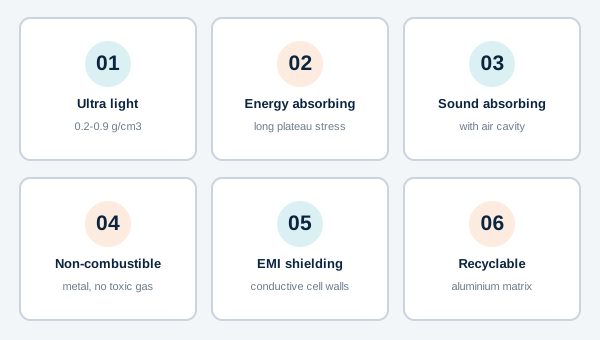
Aluminum foam — also written aluminium foam — is a cellular metal: an aluminium or aluminium-alloy matrix containing a large volume of gas-filled pores. It combines properties of metal (non-combustibility, electrical and thermal conductivity, machinability, recyclability) with properties of a porous structure (low density, energy absorption, sound absorption, thermal insulation and electromagnetic shielding).
Two fundamental pore structures
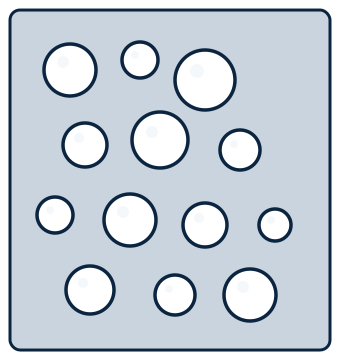
Closed-cell foam has isolated, sealed pores. It is the usual choice for energy absorption, lightweight sandwich cores, thermal insulation and structural protection. Open-cell foam has interconnected pores, allowing fluids to pass through; it is used for filtration, heat exchangers, catalyst carriers, flow conditioning and absorptive acoustic elements. The two structures are produced by different routes and their test data are not interchangeable.
| Aspect | Closed-cell | Open-cell |
|---|---|---|
| Pore network | Isolated gas pores | Interconnected channels |
| Typical use | Energy absorption, sandwich core, insulation | Filtration, heat exchange, flow-through acoustics |
| Common routes | Melt foaming, powder-metallurgy foaming | Infiltration / investment casting, deposition, additive routes |
| Mechanical role | Crushing core with a long plateau stress | Functional, usually not a primary load path |
Product forms you can buy
The material is supplied as blocks or ingots, sheets and boards, cut-to-size blanks, near-net-shape or machined parts, and as aluminum foam sandwich (AFS) panels in which a foam core is bonded, brazed or laminated between dense face sheets. Surface-opened and perforated sheets are used as acoustic facings; coloured, anodised and backlit panels are used in architecture.
A short development history
The idea of foaming metal appeared in early patent and laboratory work in the 1940s and 1950s. Through the 1960s and 1970s, production routes became more systematic and the mechanical behaviour of porous solids entered materials research. In the 1980s and 1990s, melt-foaming and powder-metallurgy foaming routes matured, the Gibson–Ashby scaling framework gave a quantitative link between relative density and mechanical properties, and industrial demonstration projects appeared in Japan and Europe. The 2000s brought sandwich panels and standardisation work; the 2010s saw larger-scale Chinese production lines and falling costs; and from the 2020s the focus has shifted towards batch consistency, joining data, certification and recycling.
Exact years and attributions vary between sources, so treat this as a chronological outline rather than a cited timeline.
Why it is specified
The appeal is structural-functional integration: one material can carry a sandwich core, absorb impact, damp vibration, resist fire and shield electromagnetic fields at the same time. That is difficult to achieve with a polymer foam or a fibrous absorber, and it is why cellular aluminium appears in highway noise barriers, rail and vehicle lightweighting, protective structures and architectural cladding.
What to check before buying
Almost every property is a function of relative density and cell structure. Always specify apparent density, average cell size and its distribution, panel dimensions, surface condition and the test standard behind each number. A density figure without a compression curve, or an absorption coefficient without the test method and air cavity, is not a usable specification.
Key takeaways
- Aluminum foam is a cellular metal, available in closed-cell and open-cell forms.
- Sandwich panels, acoustic sheets and machined absorbers are the main product families.
- Density and cell structure govern nearly all mechanical and functional properties.
- Always pair a number with its test method and build-up.