Most quotation problems with aluminum foam come from an under-specified enquiry. Two suppliers can quote "aluminum foam panel" and mean products with very different density, cell structure and performance. This checklist makes quotations comparable.
1. Define the governing requirement
Start with what the part must do: absorb a defined impact energy, meet a noise reduction target, carry a panel bending load, provide a visible finish, or shield an enclosure. Then state the applicable standard or project specification. Without a governing requirement, a density figure has no context.
2. Provide the geometric and commercial inputs
- Panel or part drawing with dimensions and tolerances
- Quantity, target delivery schedule and destination port
- Surface condition: as-cast, machined, perforated, opened, coated, coloured
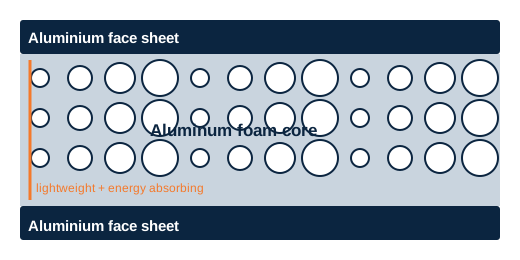
- Whether a sandwich layup is needed, and the face-sheet material and thickness
- Environment: indoor / outdoor, temperature range, humidity, salt exposure, fire rating
3. Fix the material variables
- Apparent density or relative density, with an acceptable tolerance
- Average cell size and the acceptable distribution (a small-cell 1–2 mm grade is a different product from a large-cell grade)
- Alloy and any heat-treatment or surface-treatment requirement
- Mechanical target: plateau stress, densification strain, energy absorption per volume or mass
- Acoustic target: absorption by frequency band, test method and cavity depth
4. Demand comparable data
Ask for the full compression stress–strain curve to ISO 13314 at the offered density, the density and cell-size inspection data for a representative batch, and — for acoustic panels — the absorption curve by frequency band together with the exact specimen build-up and mounting. Make sure every number carries its standard, year, specimen and boundary conditions. A single NRC or a single compressive strength is not a specification.
5. Align commercial definitions
State whether the price is per m3, per m2, per kg or per piece, and confirm which density and tolerances that unit refers to. Clarify sample cost and lead time, MOQ, packing method, Incoterm, inspection and test-report scope. Note that "nominal capacity" is not the same as qualified output — ask about yield and batch consistency.
A note on China sourcing
China offers an integrated upstream aluminium supply, large-format production lines and fast customisation for infrastructure-scale products. For high-consistency or safety-critical parts, keep the same verification discipline you would apply anywhere else: samples, third-party inspection and clearly defined test methods. Read Why Source Aluminum Foam from China for a balanced view.
Key takeaways
- State the governing requirement before the density.
- Fix density tolerance, cell-size distribution, finish and build-up.
- Request full curves, not single numbers.
- Align the pricing unit, packing and inspection scope.