
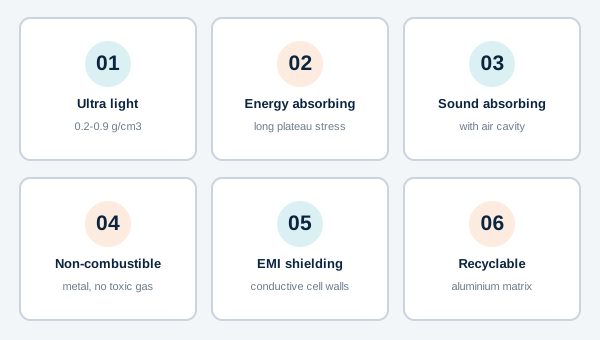
Two functional properties of aluminum foam follow directly from the fact that its skeleton is metal: it conducts electricity and heat, even at a fraction of the density of solid aluminium.
Electromagnetic shielding
An incident electromagnetic field is attenuated by reflection at the conductive surface and by absorption within the material. In a cellular metal, the connected cell-wall network forms a conductive path, so shielding can be combined with low weight and structural stiffness in a single panel. Published shielding-effectiveness figures span a wide band — commonly tens of decibels — because results depend on frequency, panel thickness, cell structure, surface condition and, critically, the electrical continuity of the panel-to-frame joint. A gap or an insulating gasket can dominate the result even when the panel itself performs well.
For a real enclosure, test the assembled unit at the frequencies of interest rather than relying on a material coupon value.
Thermal insulation with closed cells
Dense aluminium conducts heat at roughly 200+ W/(m·K). In closed-cell foam, the gas-filled pores interrupt the solid conduction path and suppress convection, so the effective thermal conductivity is commonly reported in the low single digits to about 10 W/(m·K) depending on porosity and structure. Combined with non-combustibility, that makes closed-cell foam interesting for fire separation, thermal shielding and lightweight insulating cores.
Heat transfer with open cells
Open-cell aluminium foam behaves differently: its connected pores allow a fluid to flow through a large internal metal surface, making it a candidate for compact heat exchangers, heat sinks, catalytic carriers, filters and flow conditioning. Thermal performance here is a system property — pressure drop, flow rate and the bond between foam and base plate matter as much as the foam conductivity.
Practical design issues
- Seal panel edges and frames to maintain electrical continuity.
- Avoid galvanic couples between the aluminium foam and dissimilar metals in humid or saline environments.
- Account for the large internal surface when specifying coatings or cleaning.
- For heat exchangers, verify pressure drop and the joining method (brazing, bonding, mechanical clamp).
Key takeaways
- Conductive cell walls enable EMI shielding; the frame joint often governs the result.
- Closed-cell foam insulates; open-cell foam transfers heat with fluid flow.
- Shielding and thermal figures are system-level, not just material constants.