
Aluminum foam is machinable, but it does not behave like solid aluminium. The cell walls are thin and can collapse under concentrated force, and the cut face is a porous, uneven surface.
Cutting and shaping
- Band saw / circular saw: suitable for rough blanks; use sharp, fine-tooth blades and moderate feed to reduce tearing.
- Waterjet cutting: often the best choice for complex 2D shapes because it applies little mechanical force and does not heat the material.
- Milling and drilling: possible with rigid fixtures, sharp carbide tools and controlled feed. Clamp over a large area or use a sacrificial backing plate — a point clamp can crush the cells.
- Edge finishing: cut edges expose the pore structure; frame, seal or fill them where appearance, moisture or hygiene matters.
Joining
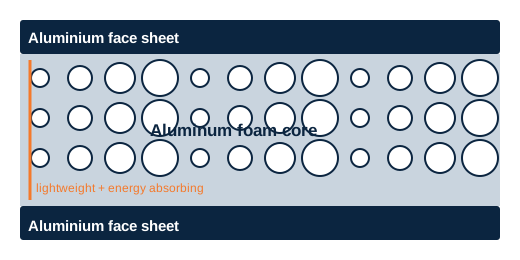
Adhesive bonding to face sheets is the most common route for sandwich panels; surface preparation and consistent bond-line thickness matter. Brazing gives an all-metal joint with no organic adhesive, but constrains alloy choice and panel size. Mechanical fastening works with spreader plates or inserts rather than a bare screw through the foam. Welding is possible but needs care with porosity, oxide layers and local collapse, and is generally not the first choice for visible panels.
Surface treatment and colour
Painting, powder coating, colour coating and anodising are used for architectural panels. Coatings change the effective open surface, so if the panel also has an acoustic function, measure absorption after finishing. For exterior use, the coating system should be selected for UV, de-icing salts and the cleaning regime.
Corrosion considerations
Aluminium passivates naturally, but a porous structure has a large internal surface area that can retain moisture and contaminants, and it is susceptible to crevice and galvanic corrosion. In humid, coastal or industrial environments: seal or coat the exposed surface, isolate dissimilar metals, provide drainage, and confirm the assembly with corrosion testing where the service life is long.
Handling and safety
Panels are light but have abrasive cut edges; use gloves and eye protection when machining, and extract dust and swarf. Fine aluminium dust should be managed according to local workshop safety rules.
Key takeaways
- Waterjet is the safest route for complex shapes; avoid point clamping.
- Bonding is common; brazing removes the organic bond line.
- Finish before acoustic testing, because coatings change the open surface.
- Seal and isolate the metal in corrosive environments.