
Technology Center
Structure, manufacturing routes, properties, standards and specification guidance for aluminum foam.
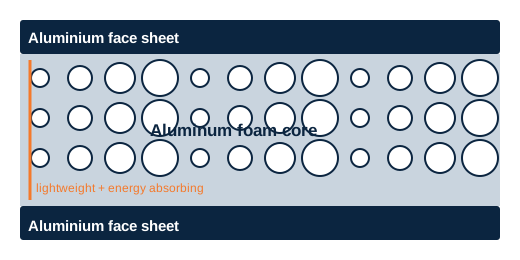
Aluminum foam is a cellular metal: an aluminium alloy skeleton surrounding a large volume of gas-filled pores. Almost everything about its behaviour follows from two variables — relative density and cell structure. This center collects the technical background you need before specifying a grade.
Structure: closed-cell and open-cell
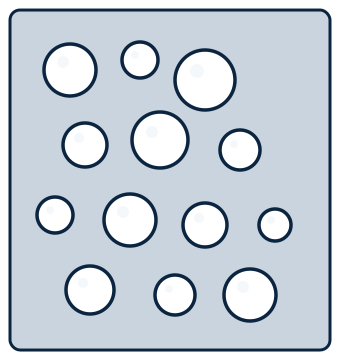
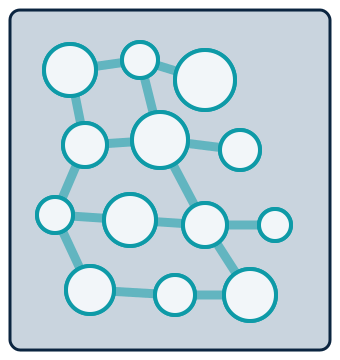
Closed-cell foam contains isolated sealed pores and is used for energy absorption, lightweight sandwich cores, thermal insulation and structural protection. Open-cell foam has interconnected pores and is used for filtration, heat exchange, catalytic carriers and flow-through acoustics. Highway noise barriers typically use closed-cell foam with a perforated or mechanically opened surface plus an air cavity behind the panel.
Manufacturing routes
- Melt foaming — a blowing agent such as TiH2 is dispersed into a viscosity-controlled aluminium melt; the melt expands and is solidified. The main route for large closed-cell boards.
- Powder-metallurgy foaming — a compacted foamable precursor expands inside a mould, giving better cell control and near-net-shape parts.
- Infiltration / investment casting — a removable template creates an open-cell network for flow-through applications.
- Gas injection and additive routes — continuous production or designed lattices for specific geometries.
Properties and how to read them
Typical apparent density is roughly 0.2–0.9 g/cm³ with porosity around 60–95% and average cell sizes from about 0.5 to 10 mm. Plateau stress (commonly in the 1–30 MPa band) scales strongly with relative density, following Gibson–Ashby-type relationships. Effective thermal conductivity is far below dense aluminium, sound absorption depends on the opened surface and cavity, and EMI shielding depends on the conductive cell-wall network and the enclosure joints.
All of these are ranges, not guaranteed values. A number is only meaningful together with the grade, density, specimen, test method and boundary conditions that produced it. See Properties & Test Methods.
Standards and testing
ISO 13314 defines quasi-static compression testing for porous and cellular metals — the reference for plateau stress and energy absorption. ASTM C423 (reverberation room) and ISO 10534-2 / ASTM E1050 (impedance tube) address sound absorption by different geometries and are not directly comparable. See Standards & Testing.
From material to product
We supply closed-cell sheets, sandwich composite panels, machined structural parts, acoustic barrier cassettes and decorative panels, with density, cell size, thickness, perforation and finish configured to drawing. Use the technical library below to go deeper, or send us your requirement for a specification proposal.

Technical library
Have an aluminum foam project to discuss?
Send us your drawing, density target or performance requirement. Our engineers will get back with a proposal.