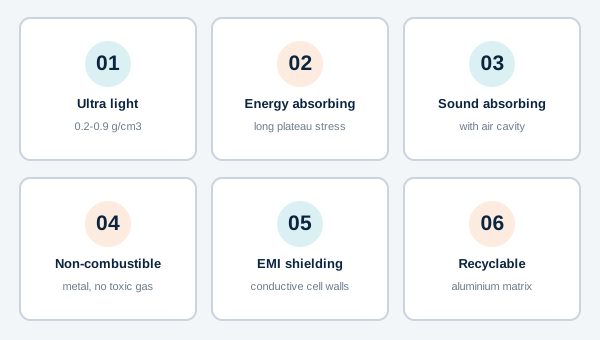

Aluminum foam is used in highway, bridge and rail noise barriers as a non-fibrous absorber. Its acoustic behaviour is real but frequently misunderstood, because absorption is a property of a panel build-up, not of the bare metal alone.
The absorption mechanism
Sound waves entering the pore network cause air to oscillate in the pores and along the cell walls. Viscous and thermal losses at the large internal metal surface convert acoustic energy into heat. For this to happen the sound must be able to get into the structure — which is why a sealed, as-cast closed-cell surface is a poor absorber, while an open-cell foam or a closed-cell panel with a perforated / mechanically opened surface works well.
Why the air cavity behind the panel matters
Absorption at low and mid frequencies depends strongly on the depth of the air gap between the absorber and the rigid backing. A panel tested flat on a hard floor behaves like a different product from the same panel mounted with a 50–100 mm cavity. Cavity depth, perforation ratio, panel thickness and whether the pores are interconnected must all be fixed before a coefficient has meaning.
Comparing published numbers
| Method | What it measures | Comparable to |
|---|---|---|
| ASTM C423 (reverberation room) | Random-incidence absorption of a large specimen, often reported as NRC | Other reverberation-room results with the same mounting |
| ISO 10534-2 / ASTM E1050 (impedance tube) | Normal-incidence absorption of a small sample | Other impedance-tube results with the same tube and cavity |
Values from the two methods are not directly comparable, and a single NRC number hides the frequency curve. Ask for absorption coefficients by octave or third-octave band plus the exact specimen and mounting description. Typical published sound absorption coefficients for cellular metal build-ups fall roughly in the 0.4–0.9 band depending on all of the above.
Why a metallic absorber outdoors
Conventional fibrous absorbers can absorb water, settle, shed fibres and lose performance after years of weather exposure. An all-metal absorber is non-combustible, does not produce toxic smoke, is dimensionally stable under UV and temperature cycling, and can be cleaned or replaced as a modular cassette. That is why aluminum foam is attractive for road, bridge and rail corridors with long maintenance intervals.
Specification checklist
State the target noise reduction or required absorption by frequency band, the test method and standard, the panel build-up including cavity depth and perforation pattern, the frame and fixing system, and the corrosion protection / coating for the exposure class. Then compare supplier data measured under those conditions.
Key takeaways
- Sound must enter the pores — sealed closed-cell foam is not an absorber on its own.
- The air cavity is part of the acoustic design.
- ASTM C423 and impedance-tube results cannot be compared directly.
- Always request the full frequency curve and the exact build-up.