
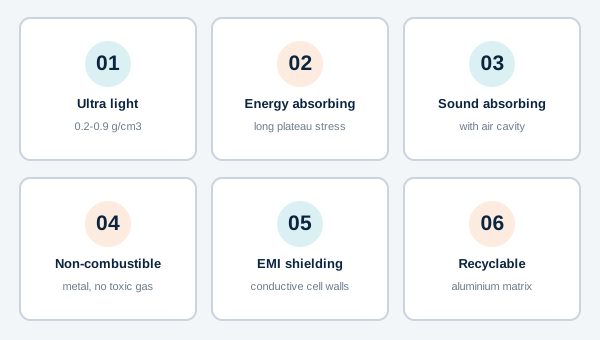
This page collects the property ranges most often requested by engineers, with the caveat that matters most: almost every value is a function of relative density and cell structure. Treat the table as orientation for a specification, not as a datasheet for a batch.
Typical ranges
| Property | Indicative range | Main dependency | Test reference |
|---|---|---|---|
| Apparent density | about 0.2–0.9 g/cm3 | Foaming route, blowing-agent amount | Mass / volume of a defined specimen |
| Relative density | about 0.07–0.35 | Foam density vs solid alloy density | Calculated |
| Porosity | about 60–95% | Expansion ratio | Density or image analysis |
| Average cell size | about 0.5–10 mm (closed cell commonly 1–8 mm) | Foaming and solidification control | Image analysis / section counting |
| Plateau stress | roughly 1–30 MPa | Strongly relative-density dependent | ISO 13314 compression |
| Densification strain | about 0.4–0.8 | Density, cell-wall plasticity | ISO 13314 compression |
| Effective thermal conductivity | roughly 1–10 W/(m·K) (dense Al is 200+) | Porosity, open vs closed cells | Guarded hot plate / laser flash, specimen-specific |
| Sound absorption coefficient | roughly 0.4–0.9 | Open surface, cavity, mounting, frequency | ASTM C423 or ISO 10534-2 |
| EMI shielding effectiveness | tens of dB (commonly 30–80 dB quoted) | Frequency, thickness, frame continuity | Shielding-effectiveness test on the assembly |
| Fire behaviour | non-combustible metal | Alloy, coating, adhesive, assembly | Applicable building / transport fire standard |
These are ranges reported across public technical literature and product experience. A value is only meaningful when paired with the grade, density, specimen geometry, method and boundary conditions that produced it.
Why values differ by an order of magnitude
Plateau stress scales strongly with relative density — in the Gibson–Ashby framework, roughly with a power around 1.5–2. A low-density architectural panel and a high-density crash absorber can therefore differ by an order of magnitude while both being "aluminum foam". The same applies to energy absorption per unit volume, which tracks plateau stress and usable stroke.
Acoustic data needs its build-up
Sound absorption is not an intrinsic constant. The measured coefficient changes with the test method (reverberation room vs impedance tube), the air cavity behind the panel, the perforation or opening pattern, the specimen area and the mounting. Compare only data obtained with the same method and the same assembly.
How to write a defensible specification
Write each requirement as: property — value or range — test standard and year — specimen and build-up — acceptance criterion. For example: "plateau stress X–Y MPa at density Z g/cm3, measured per ISO 13314 on specimens of defined dimensions, with the mean and standard deviation reported for the batch." That format makes two supplier quotations comparable.
What we supply
For qualified projects we provide product datasheets, compression curves, density and cell-size inspection data for representative batches, and samples for your own testing. Third-party inspection can be arranged before shipment.
Key takeaways
- Every property depends on density and cell structure.
- Pair each number with its standard, specimen and build-up.
- Reverberation-room and impedance-tube acoustic data are not comparable.
- Confirmed values come from the batch datasheet and test report.