
Buyers often compare aluminum foam with two very different materials: aluminium honeycomb (a structural core) and mineral wool (an acoustic absorber). The right comparison depends on which requirement governs.
Aluminium honeycomb
Honeycomb is a regular, two-dimensional periodic cell structure. It delivers exceptional stiffness-to-weight in the directions it is designed for and is well established in aerospace and panels. Its behaviour is strongly anisotropic, and it does not provide the long plastic-collapse plateau that makes a stochastic foam useful for impact energy absorption. Cells can also trap moisture if the panel is damaged. Choose honeycomb when stiffness per kilogram dominates and the load directions are known.
Mineral wool / fibrous absorbers
Mineral wool is an inexpensive, effective broadband absorber and is the default in many noise barriers. It is non-combustible in itself, but the overall cassette may involve binders, facings and water management; fibres can shed, settle or hold moisture over long service intervals. Choose it when acoustic performance per cost dominates and the assembly is well protected.
Aluminum foam
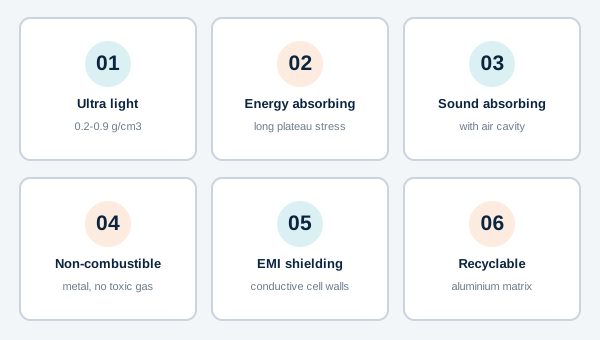
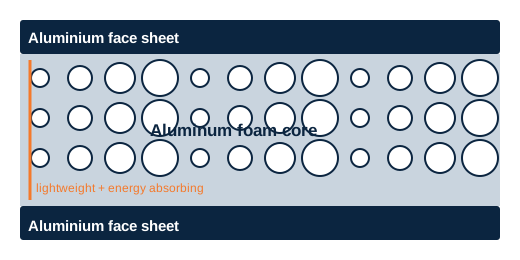
Stochastic closed-cell foam is roughly isotropic, absorbs impact energy through progressive cell collapse, damps vibration and remains a non-combustible, recyclable metal. With an opened or perforated surface plus an air cavity it also works as an absorber. It is heavier than polymer foam and more expensive than mineral wool per square metre, so its value appears where several functions must be combined, or where long-term durability and fire behaviour matter more than the lowest initial price.
Side-by-side
| Criterion | Aluminum foam | Honeycomb | Mineral wool |
|---|---|---|---|
| Specific stiffness (as a core) | High | Very high, directional | Not structural |
| Isotropy | Largely isotropic | Anisotropic | n/a |
| Impact energy absorption | Excellent (long plateau) | Limited | Limited |
| Fire / smoke | Non-combustible metal | Non-combustible metal | Non-combustible fibre, binder-dependent |
| Acoustic absorption | Good with opened surface + cavity | Poor without treatment | Excellent |
| Moisture behaviour | Metal; seal against corrosion | Cells can trap water | Can hold water / shed fibre |
| Recyclability | Aluminium remelt | Aluminium, but bonded assemblies need separation | Limited |
| Initial material cost | Higher | Medium–high | Low |
A practical decision rule
If the governing requirement is stiffness at minimum mass, start with honeycomb. If it is broadband absorption at minimum cost, start with mineral wool. If you also need impact energy management, fire safety, damping, a visible metallic surface and a long outdoor service life, aluminum foam becomes competitive — especially as a multi-functional sandwich core.
Key takeaways
- These materials solve different primary problems; compare against the governing requirement.
- Foam wins where functions must be combined and durability matters.
- Acoustic numbers must still be compared with the same test method.