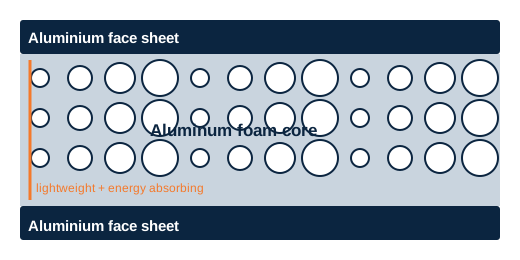
An aluminum foam sandwich (AFS) panel is a three-layer construction: two dense face sheets separated by a closed-cell aluminum foam core. It is the most common way to turn a lightweight foam into a stiff, usable structural panel.
Why sandwiches are stiff
In bending, the face sheets carry most of the tensile and compressive forces while the core keeps them apart and carries shear. Because bending stiffness grows rapidly with the separation of the skins, an AFS panel can reach high stiffness at far lower areal weight than a solid sheet of the same metal. The foam core also adds damping, impact energy absorption, thermal insulation and fire safety.
Core and skin options
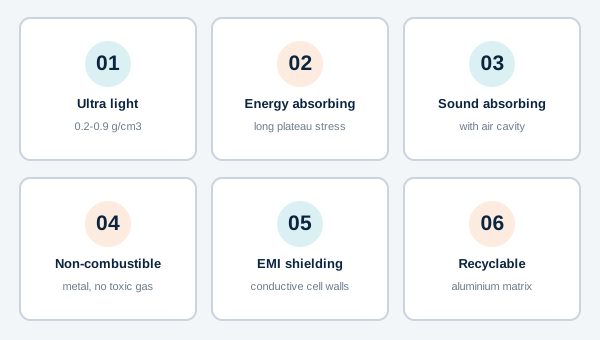
- Core: closed-cell foam with density chosen for the required shear and compression behaviour (typical apparent density roughly 0.2–0.9 g/cm3).
- Skins: aluminium sheet is most common; other metals or composites can be considered depending on fire rating and environment.
- Joining: structural adhesive bonding, brazing for an all-metal joint, or mechanical fastening / co-forming routes.
- Edges: sealed, framed or closed profiles to protect the core and provide fixing points.
Failure modes to check
A sandwich panel does not fail like a solid plate. Design checks normally include face-sheet yielding or buckling, core shear failure, core indentation under concentrated loads, skin–core debonding, and the behaviour of inserts and fixings. Fatigue of the bond line and galvanic corrosion at dissimilar-metal joints also need attention in long-life or outdoor applications.
Versus other cores
| Core | Strength | Trade-off |
|---|---|---|
| Aluminum honeycomb | Very high specific stiffness in defined directions | Anisotropic; moisture ingress in cells; limited energy absorption |
| Polymer foam | Low cost, easy to bond | Combustible, smoke and temperature limits |
| Aluminum foam | Isotropic, energy absorbing, non-combustible, damping | Higher density than polymer foam; needs joining and edge design |
What to ask a supplier
Request panel-level bending and shear data for the exact layup, not only a core compression curve; confirm the joining process and its durability in your environment; and define the edge and fixing detail before the panel thickness is frozen.
Key takeaways
- Skin separation creates bending stiffness; the foam core carries shear and absorbs energy.
- Joining method and edge detail are as important as the core grade.
- Check indentation, debonding and inserts, not just global bending.