Choosing between open-cell and closed-cell aluminum foam is the first specification decision, and it is often made too late. The two materials share an aluminium matrix but behave differently because of how their pores connect.
Structure and how each is made
Closed-cell foam consists of individual sealed gas bubbles separated by aluminium cell walls. It is typically made by introducing a blowing agent (for example TiH2 or CaCO3) into a thickened aluminium melt, or by heating a compacted powder-metallurgy precursor so that it expands into a foam. Both routes suit large-format boards and near-net-shape parts.
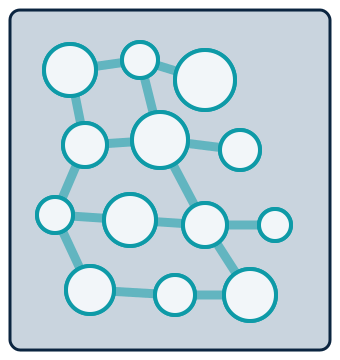
Open-cell foam has a connected network of pores. It is commonly produced by infiltration or investment casting around a removable space-holder, by deposition onto a sacrificial template, or by additive manufacturing of a designed lattice. These routes offer control over pore connectivity but are usually more expensive per unit volume.
Mechanical behaviour
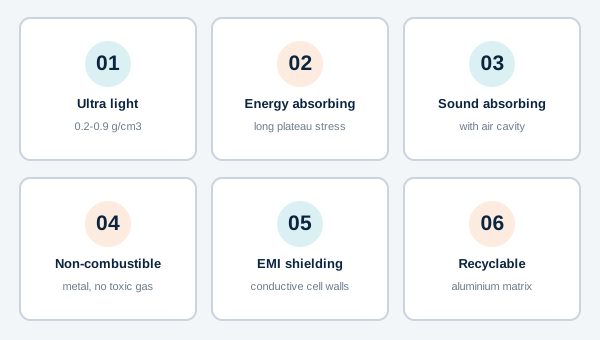
Closed-cell foam shows the classic three-stage compressive stress–strain response: a short elastic region, a long plateau where cell walls collapse progressively, and a final densification region where the collapsed material stiffens rapidly. The plateau is what makes the material useful for crash and blast energy absorption. Open-cell structures tend to behave more like a bending-dominated lattice and are generally selected for function rather than for high energy absorption per unit volume.
Acoustics, thermal and electrical behaviour
Sound absorption requires sound energy to enter the pore network and dissipate — so open-cell foam, or closed-cell foam with a perforated / opened surface and an air cavity behind it, is used. Sealed closed-cell foam on its own is a relatively poor absorber but a good thermal insulator: the gas-filled pores interrupt solid conduction, giving an effective thermal conductivity far below that of dense aluminium (roughly 200+ W/(m·K)). Both structures remain electrically conductive, which is the basis for EMI shielding.
How to decide
| Your priority | Likely choice |
|---|---|
| Crash energy absorption, protective structures | Closed-cell |
| Lightweight sandwich core, stiffness | Closed-cell (AFS panel) |
| Thermal insulation, fire separation | Closed-cell |
| Highway / rail noise barrier absorber | Closed-cell with opened or perforated surface + cavity |
| Filtration, heat exchanger, catalyst carrier | Open-cell |
| Flow conditioning, some acoustic liners | Open-cell |
A note on test data
Because the two families are tested differently, never compare a compression curve for a closed-cell foam with a flow-resistance or permeability figure for an open-cell foam as if they were grades of the same product. State the structure explicitly in the enquiry.
Key takeaways
- Closed-cell = sealed pores, energy absorption and insulation.
- Open-cell = connected pores, flow-through function.
- Acoustic barriers usually use opened closed-cell foam with a cavity.
- Match the test method to the structure.