
Test standards are the most frequently mixed-up part of an aluminum foam specification. The three families below measure different physical quantities and cannot be substituted for one another.
ISO 13314 — compression of porous and cellular metals
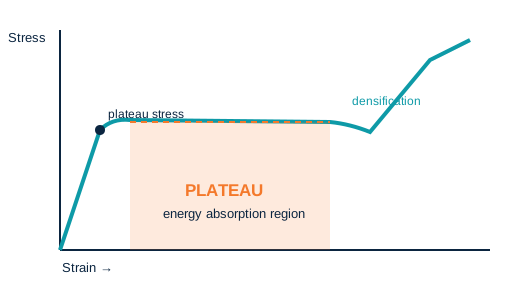
ISO 13314 (Mechanical testing of metals — Ductility testing — Compression test for porous and cellular metals, first published in 2011) defines a quasi-static compression test for porous and cellular metals. It is the reference for obtaining the compressive stress–strain curve, plateau stress, plateau end / densification strain and energy absorption. When a supplier quotes plateau stress or energy absorption, this is the mechanical method to ask about — including specimen dimensions, strain rate and how the plateau was averaged.
ASTM C423 — reverberation-room absorption
ASTM C423 (Standard Test Method for Sound Absorption and Sound Absorption Coefficients by the Reverberation Room Method) measures random-incidence sound absorption of a relatively large specimen in a reverberation room. It is the basis for many published absorption coefficients and NRC-type ratings. Results depend on specimen area, mounting and the air cavity, so the mounting description is part of the result.
ISO 10534-2 / ASTM E1050 — impedance tube
These methods measure normal-incidence absorption using a small sample in an impedance tube. They are efficient for material development and comparing surface variants, but the numbers are not directly comparable with reverberation-room values. If a datasheet quotes a single "absorption coefficient" without naming the method, ask before using it.
The common mistake
Using compression data to justify an acoustic claim, or comparing absorption coefficients from different methods, is the standard error in foam specifications. Mechanical standards and acoustic standards measure different things. A further trap is writing only a standard number without the year, specimen and boundary conditions — the same number can refer to different test geometries.
Other standards that may appear in a project
Depending on the application, a project may also invoke fire-reaction classifications, panel bending or shear tests, corrosion tests, fatigue tests, or transport-specific material standards. Those are assembly-level or regional requirements; confirm the exact designation and edition with the project engineer or an accredited laboratory. Do not assume a general "GB/T" or "ASTM" number covers compression or acoustics without checking its scope.
A clean way to cite data
"Plateau stress: X MPa (mean of n specimens), apparent density Z g/cm3, ISO 13314, specimen dimensions A×B×C, strain rate R." — plus "Absorption coefficient by frequency band, ASTM C423, mounting type M, cavity depth D mm." That level of detail is what makes two offers comparable.
Key takeaways
- ISO 13314 = compression / energy absorption.
- ASTM C423 = reverberation-room absorption.
- ISO 10534-2 / ASTM E1050 = impedance-tube absorption.
- Always include year, specimen, mounting and boundary conditions.