
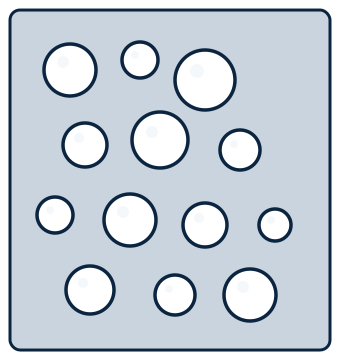
If you remember one idea about aluminum foam, make it this: relative density is the master variable. It links the manufacturing process to almost every mechanical and functional property a buyer cares about.
What relative density is
Relative density is the density of the foam (ρ*) divided by the density of the solid metal it is made from (ρs). A 0.3 g/cm3 aluminium foam therefore has a relative density of roughly 0.11. Porosity is the complement: 1 − ρ*/ρs. Both describe the same structure, but relative density is the more useful one for mechanical design.
The scaling idea
In the Gibson–Ashby framework for cellular solids, properties scale as a power of relative density. Relative stiffness and relative plateau strength are commonly approximated with exponents in the range of about 1.5–2 for closed-cell metal foams (exact values depend on whether cell-wall bending, stretching or membrane behaviour dominates). The practical consequence: doubling relative density can raise plateau stress by roughly three to four times, not two.
Why "as light as possible" is the wrong target
Lower density simultaneously reduces plateau stress and the absolute energy that can be absorbed per unit volume. The engineering target is normally: meet the required plateau force and energy absorption within the available crush distance, then minimise mass. Specifying the lowest available density first, and only then checking the load case, usually leads to an absorber that bottoms out.
A simple selection sequence
- Define allowable peak force and available crush stroke.
- Compute the energy to be absorbed (area under the force–displacement curve).
- Choose a plateau stress and densification strain that fit that window.
- Select the density that produces that plateau stress, with a tolerance band.
- Verify with ISO 13314 compression curves on samples of the offered density.
Where the scaling model stops
Real foams have non-uniform cell sizes, missing or ruptured cell walls, a dense surface skin, and alloy and heat-treatment effects. Dynamic loading, temperature and corrosion change the picture further. Scaling laws are excellent for reasoning and shortlisting, but batch test data is what you buy against.
Key takeaways
- Relative density = foam density / solid metal density.
- Plateau stress scales roughly with density to a power of 1.5–2.
- Design from the energy and force target, then pick density.
- Validate with batch compression curves.