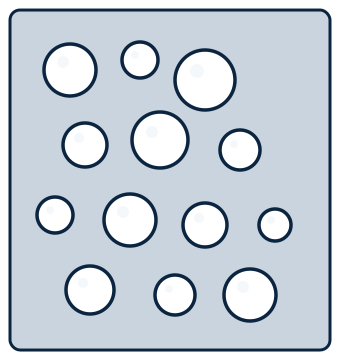

Two foam panels can share the same quoted "average cell size" and behave very differently. The reason is distribution: a broad mix of large and small pores creates weak regions where collapse starts early and plateau stress becomes less predictable.
What uniformity changes
A narrower cell-size distribution gives more consistent plateau stress, a smoother compression curve, more predictable acoustic behaviour and a cleaner machined surface. It also reduces the scatter in density across a large board. In energy-absorbing parts, scatter matters because the weakest region determines where collapse begins.
The small-cell development
Reducing average pore diameter while keeping the distribution tight is a recognized route to improving mechanical properties. Our R&D cooperation with Tsinghua University includes work on small-cell foam with an average pore diameter of about 1–2 mm and a more uniform pore distribution, together with optimised solidification control. That is a capability statement about a grade, not a claim about every product we ship.
What to request
- Apparent density with a tolerance band, measured at defined positions across the board
- Cell-size distribution (not just an average), with the measurement method and sample location
- Compression curves to ISO 13314 for the offered density, with the number of specimens and scatter
- Surface and skin condition after cutting or machining
- Batch identification and traceability linking the shipped panels to the inspection record
- Third-party inspection scope, if the project requires it
A practical acceptance test
Define an acceptance protocol before the order: sample positions, specimen dimensions, the density tolerance, the minimum plateau stress and the maximum scatter. Agree what happens when a batch falls outside the band. This is far more effective than arguing over a generic datasheet after shipment.
The broader quality picture
Pore control sits alongside surface treatment, yield control, joining consistency and corrosion protection as part of a supplier quality system. Ask how the process is controlled in real time, not only how the finished panel is inspected.
Key takeaways
- Distribution matters more than the average cell size.
- Uniformity improves plateau stress predictability and surface quality.
- Request density maps, cell-size distributions and batch traceability.
- Write the acceptance protocol into the order.